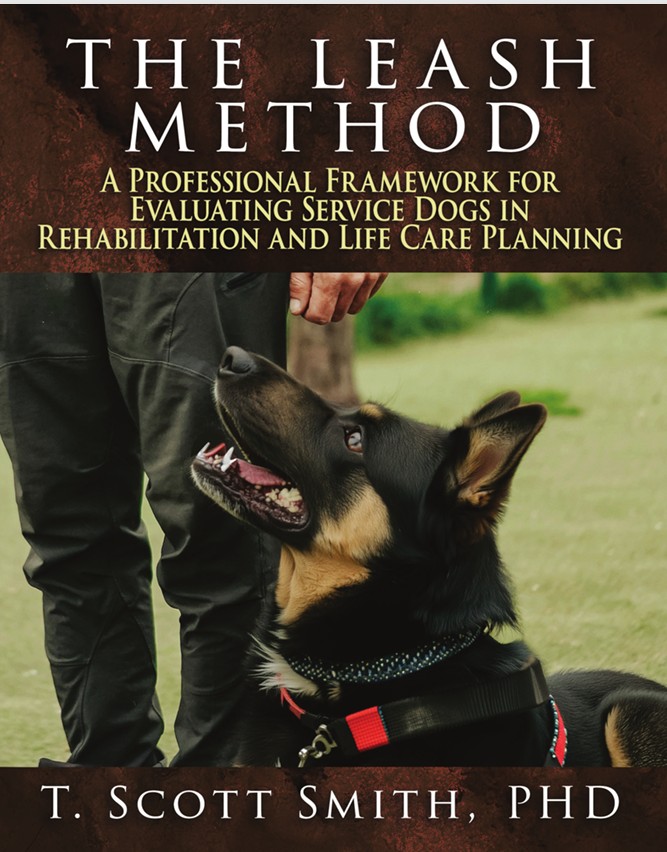
The LEASH
Method
When is a service dog an appropriate, reasonable, and supportable recommendation? LEASH offers a structured way to examine functional need, evidence, alternatives, and long-term feasibility.
By T. Scott Smith, PhD, LRC, CRC, CLCP
Moving beyond “would a service dog help?”
A helpful animal is not necessarily a supportable professional recommendation.
Service dogs may provide meaningful assistance, but they also require careful consideration of functional need, alternatives, training, handler readiness, ongoing care, and costs.
LEASH helps professionals distinguish potential benefit from documented need. It organizes information and supports individualized, clearly explained conclusions about the appropriateness of a service dog.
A structured way to reach a recommendation
Five connected considerations help guide evaluation and documentation in rehabilitation, life care planning, and related professional settings.
Limitations
Identify the functional limitations that create a need for assistance.
Evidence
Evaluate the clinical, functional, and professional basis for the proposed support.
Alternatives
Consider other services, accommodations, technologies, and supports.
Sustainability
Examine costs, training, care, safety, and longer-term viability.
Human-Animal Fit
Evaluate handler capacity, circumstances, support, and practical compatibility.
Use the LEASH framework to organize information, identify gaps, and explain professional recommendations.
Developed for professionals who must assess and explain recommendations
LEASH is intended for people who evaluate, recommend, document, fund, or examine animal-related support as part of disability and rehabilitation planning.
- Life care planners
- Attorneys and legal experts
- Healthcare professionals
- Case managers
- Rehabilitation counselors
- Vocational professionals
- Claims professionals
- Service dog professionals

Printable LEASH resources
Selected worksheets and tools from the book support organized assessment, practical implementation, and clear documentation. Start with these five forms from the LEASH Starter Toolkit.
Four-Question Animal Support Worksheet
Clarify the proposed role of the animal and the threshold questions that guide further review.
LEASH Worksheet
Record findings across the five LEASH considerations and document the resulting recommendation.
Service Dog Cost Projection Worksheet
Document and project the initial, ongoing, and replacement costs of a service dog.
Handler Capacity / Readiness Self-Assessment
Review the practical demands of working with and caring for a service dog.
Alternatives Worksheet
Document and compare available supports, technologies, and accommodations.
Additional Information
Publications, worksheets, and video content.

T. Scott Smith, PhD
Licensed Rehabilitation Counselor · Certified Rehabilitation Counselor · Certified Life Care Planner
Dr. Smith has more than three decades of experience in rehabilitation counseling, vocational evaluation, life care planning, and disability-related consultation. His work focuses on turning complex clinical and functional information into practical recommendations that can be understood and explained.
He developed the LEASH framework to help professionals consider service-dog recommendations through consistent, individualized analysis rather than assumptions about the value of an animal.
Make service-dog recommendations with greater structure and clarity.
Read the framework, use the accompanying tools, or reach out to Dr. Smith about the book and related professional questions.